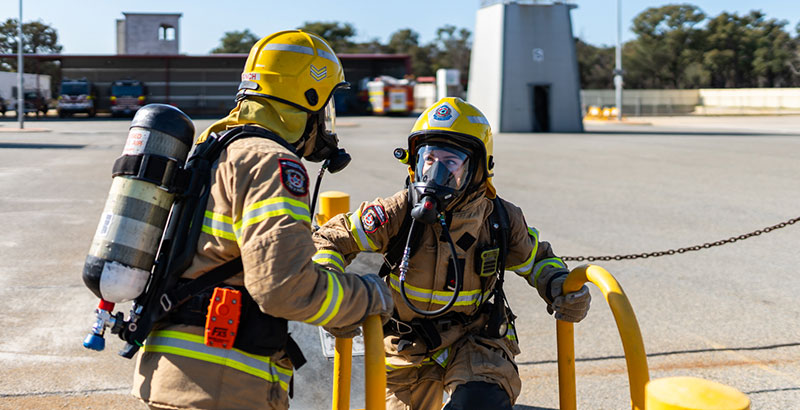
Are you a team player? Resilient, compassionate and courageous? You might have the qualities we're looking for. Subscribe to receive the latest news and updates regarding firefighter recruitment.

Becoming a career firefighter is more than simply taking on a job. It’s a step into a career that really matters. At DFES, we look for passionate people who are committed to supporting our vision and our mission. We look for qualities like courage, commitment and compassion.
You don’t need any previous firefighting experience to apply. What you do need to be is an adaptable team player who is ready to learn new skills and apply them in stressful, time-critical environments.
Selection is a multi-stage process. You’ll undergo several behavioural, cognitive and physical assessments that align with the requirements of firefighting and DFES’ Core Values.
To become a career firefighter, you need to meet several essential prerequisites. Original or certified copies of all prerequisites must be provided to DFES at various stages of the recruitment process.
The first stage of the recruitment process is submitting an online application via WA Government Jobs.
There are four essential documents that you must attach to your application:
If successful, you will be required to obtain and provide all of the following checks and qualifications as you progress through the recruitment process:
Prerequisite qualifications are not provided by DFES. All essential prerequisites, including licences and training certificates, must be current (expired certificates or licences will not be accepted) and obtained by applicants before any offer of employment.
When applications open, a job listing will be posted to WA Government Jobs.
It is important that you attach the following four documents to your application:
Failure to attach the four correct documents to your application will result in you being removed from the selection process. All essential prerequisites, including licences and training certificates, must be current (expired certificates or licences will not be accepted).
For more information about these required documents, refer to the eligibility section of this website or visit WA Government Jobs.
The cognitive assessment evaluates the skills needed to successfully complete the academic components of trainee firefighter school. You may be asked to complete a range of tasks that assess your ability to understand written information, work with numbers, apply mechanical reasoning, interpret diagrams, identify errors and demonstrate spatial awareness.
The personality assessment explores your personal traits, preferences and behavioural style. This assessment helps determine how well your strengths and behaviours align with the traits required for career firefighters to perform effectively in the role.
The following physical aptitude assessments are designed to evaluate your fitness, strength, endurance and ability to perform under the challenging conditions that firefighters face.
It’s important to note that applicants are assessed on whether assessments are completed in a safe manner and as instructed, rather than being based on technique.
Applicants only have one opportunity to pass each assessment, so we strongly encourage you to begin preparing as early as possible. The Physical Aptitude Test Training Guide provides useful information on physical preparation to assist with maximising performance during this stage of the recruitment process.
The beep test (also known as the shuttle run) measures an applicant’s level of cardiovascular fitness. To progress, you must achieve a minimum score of 8.7, requiring you to run back and forth over a 20-metre course in time with a series of audio beeps, covering 1,360 metres in 8 minutes and 4 seconds. Applicants who fail to reach 8.7 will be removed from the recruitment process.
This pass or fail test gauges your ability to work in confined and potentially claustrophobic environments. Applicants must navigate a series of tunnels and obstacles while wearing breathing apparatus and a frosted mask. This assessment must be completed in 10 minutes in order to pass/or will be removed from recruitment process.
The circuit test must be completed in under 25 minutes while wearing breathing apparatus or a 14kg weighted vest.
The Tasks may include:
The written assessment task is submitted with your online application in Stage One and assessed before the interviews. It tests your ability to review information, analyse key details and present a clear, concise and professional response.
The speed interviews require applicants to sit down one-on-one with an assessor and answer interview style questions. The speed interviews involve small groups of applicants being interviewed and assessed by four panel members in a single session. Applicants will rotate assessors every 10 minutes, a total of four times. The interview questions are designed to assess applicants’ behaviours, competencies and experiences.
These interviews are in front of four panel members, which may include operational DFES personnel, non-operational DFES personnel and external consultants. A current copy of your CV must be provided before the interview.
The driving proficiency evaluation is overseen by driving instructors from the DFES training academy. The assessment will review each applicant’s ability to safely handle a heavy rigid vehicle and capacity to be trained to a level sufficient to drive safely and efficiently in emergency situations. The driving instructor will provide applicants with feedback regarding the currency of the applicant’s driving skills and provide some advice as to how they can further build on their skills prior to a possible commencement with the Trainee School.
These examinations, undertaken by a medical practitioner appointed by DFES, are designed to highlight any conditions that would prevent or hinder an applicant from effectively carrying out firefighting duties and which may put the individual, colleagues, or members of the community at risk. The medical practitioner provides DFES with an applicant’s suitability for the role of firefighter based on all the information available to them.
Applicants who do not meet the required standards of any part of the medical examination will not be offered a position as a firefighter. Where any increased risk of injury or other potential issues is identified, these will be considered, taking into account the nature of the concern and the likelihood of injury or other impact.[AR4.1] Examples of medical conditions generally considered incompatible with unrestricted operational firefighting duties include, but are not limited to: asthma, previous heart attack, implantable defibrillators, epilepsy, diabetes requiring insulin, hearing aids, permanent need for blood thinning medications, joint replacement surgery or eyesight disorders.
When requested, applicants are required to obtain their:
All applicants must undergo referee checks.
Stages and assessments are subject to change at any time. It is important to note that not all applicants who are successful in each stage will progress to the next stage of assessment. Details of dates, times and location for each assessment stage will be provided to applicants as they progress through the selection process.
Fire and rescue is a job unlike most others. It’s important to consider your expectations and the commitments you’ll need to make before you apply.
You could be posted to any regional or metropolitan career fire station, and you must be prepared for the realities of rostered shift work, plus fixed leave. Until you are appointed to a station permanently, you’ll likely be in the relieving pool working at different stations.
Once you have commenced on station, you work a cycle of four days on duty followed by four days off. This amounts to an average of 42 hours per week and consists of two 10-hour day shifts (0800 to 1800) followed by two 14-hour night shifts (1800 to 0800). Firefighters are paid for 40 hours per week with the additional two hours per week accruing as additional annual leave.
Current Firefighter Rates of Pay (Inclusive of Allowances)
Classification
Weekly Wage
(effective on and from June 2024)
Yearly Wage
(effective on and from June 2024)
Trainee Firefighter
$1,730.00
$90,263.98
5th Class Firefighter
$1,863.20
$97,196.93
4th Class Firefighter
$1,896.50
$98,934.08
3rd Class Firefighter
$1,979.60
$103,269.13
2nd Class Firefighter
$2,029.40
$105,867.03
1st Class Firefighter
$2,195.60
$114,537.13
Senior Firefighter
$2,278.70
$118,872.18
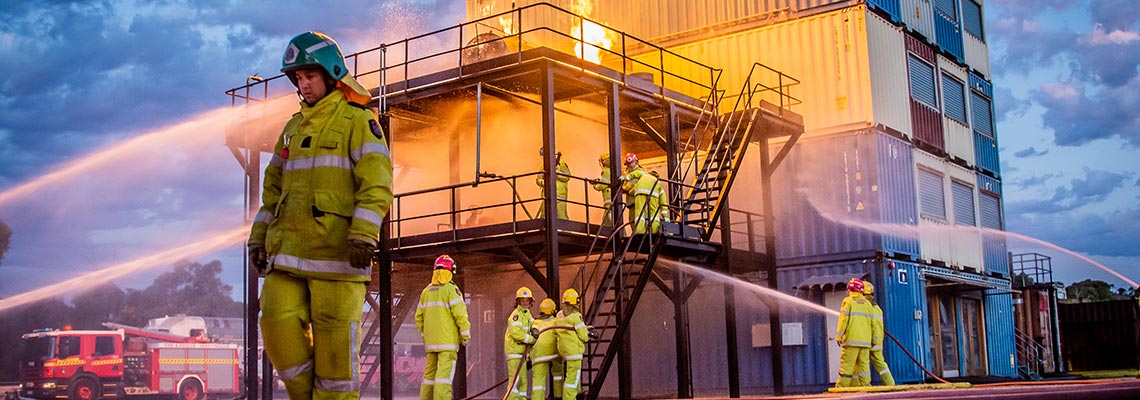
If you’re selected to attend the Trainee Firefighter School, you’ll be offered a temporary contract to complete an intensive 15-week training program at the Western Australia Fire and Emergency Services Academy in Forrestfield. This school is not a live-in program and trainees are required to arrange their own accommodation where necessary.
Trainees will need to be proficient in various computer software packages to successfully complete the theoretical and practical components of the program. Most of the training is conducted at the Academy, with excursions to other locations when required. The hours of duty at the school are generally Monday to Friday between 0700hr and 1700hr; however, trainees may be required to work weekends and/or evenings, often with little notice.
Throughout the course, you’ll develop the base level skills and knowledge needed to commence your career in firefighting. Training covers firefighting skills, community safety, breathing apparatus operations, rescue procedures, hazardous materials response, emergency vehicle driving and workplace communication skills.
Trainee Firefighter School graduates will be promoted to 5th Class Firefighter and begin working shift-based rosters as part of an operational crew.
Over the next five years, you’ll complete the compulsory Firefighter Development Program and progress towards the rank of Senior Firefighter.
From here you have the chance to pursue training opportunities and undertake a recruitment process that would allow you to specialise in Urban Search and Rescue, Training and Instructing, Aerial Rescue, Air Intelligence, Communications, Analysis, Logistics and Fire Investigation.
When applications open, the first stage of the recruitment process is submitting an online application via WA Governemt Jobs.
There are four (4) essential documents that you must attach to your application:
There is no minimum age to apply for a Career Firefighter position. However, you must be able to obtain a Heavy Rigid (HR) vehicle licence within five months of your application to progress through the final validation stage of the recruitment process.
To apply for a heavy vehicle class licence, you must have held your Manual (C class) licence for two years and no longer be considered a provisional licence holder.
For more information about obtaining your HR licence, please visit the Transport WA website.
You need an unrestricted Manual (C Class) vehicle licence to apply.
If successful, you will be required to hold or obtain a current Western Australian or National Heavy Rigid (HR) vehicle licence that allows you to operate manual HR vehicles with a synchromesh gearbox within five (5) months of applications closing.
Visit the Department of Transport website for information about obtaining a Manual (C Class) licence or Heavy Rigid (HR) vehicle licence.
DFES advertises all vacancies via Jobs WA and the DFES Jobs Board.
You can also register your interest to be notified about future rounds of firefighter recruitment and monitor the DFES website and our social media pages for updates.
No, there are no minimum schooling requirements. However, basic computer skills are essential for participating in training and navigating coursework at the Training Academy.
Successful applicants who go on to graduate from the Training Academy are accredited with the following qualifications:
Yes, each application is a separate selection process. You are strongly encouraged to reapply if you remain interested in becoming a firefighter.
Pool recruitment refers to a number of persons being selected by a panel as suitable to be considered for appointment to fill future vacancies in Trainee Firefighter Schools.
Generally, a pool operates for a period of 12 months from the date of initial placement into the pool. Applicants who have been assessed as suitable through the merit selection process (Stage 1 – Stage 4) can be considered for selection to the firefighter pool.
Suitable applicants are conditionally appointed to the pool and may be offered positions in the Trainee Firefighter School as positions arise. Appointment from the pool to a vacancy in the Trainee Firefighter School is not automatic. Should a position not arise during the life of the pool, applicants will need to reapply for the next Firefighter Recruitment Campaign.
No, you are not required to submit a CV/Resume with your initial application and are strongly encouraged to follow the instructions outlined in the advert on Jobs WA. Your resume and other documents will be requested at a later date should you progress through the recruitment stages.
The first four stages of the recruitment process take approximately five (5) months once applications close.
Successful applicants are conditionally appointed to a pool. Applicants from this pool are then contacted to participate in Stage 5: Final Validations. Only applicants being considered for appointment to a specific Trainee Firefighter School intake are contacted to complete Stage 5.
No. Generally, there are more applicants in the Firefighter Recruitment Pool than there are positions available.
The Trainee Firefighter School (TFFS) takes just over 15 weeks to complete.
The majority of the training is conducted at the Training Academy, with excursions to other areas when required. The hours of duty at the school are generally Monday to Friday between 0700 and 1700; however, trainees may be required to work weekends and/or evenings, often with little notice. Therefore, it is advised that you clear your schedule over this period, including participation in team sports and other non-essential commitments you may have.
This school is not a live-in program, and trainees are required to arrange their own accommodation where necessary.
Yes, we welcome applications from anywhere. However, you must meet the eligibility requirements and be able to attend assessments in person when required. Assessment locations are usually within the Perth Metro area.
You will need to complete the full 15 week trainee firefighter school and RPL will not be considered during this time. Once you graduate and begin your five (5) year Firefighter Development Program, you can apply for recognition of nationally recognised units of competency or qualifications. However, recognition of existing units of competency or qualifications does not remove the requirement to complete or shorten the duration of the FDP, inclusive of fast-tracked attainment of rank.
No. DFES does not currently accept requests for lateral transfers from other States or Territories within Australia or other countries. In order to undertake a Career Firefighter position with DFES you will need to complete the full 15 week trainee firefighter school and undertake the compulsory five (5) year Firefighter Development Program.
All applicants invited to Stage 5: Final Validations will undergo a comprehensive pre-employment medical assessment. Pre-employment medical assessments are conducted by an independent Occupational Physician. These assessments are carried out on a case-by-case basis, with a thorough review of each applicant’s medical history, how well the condition is managed, and any potential impacts on the role. The examination is designed to identify any conditions that may prevent or hinder an applicant from safely and effectively performing all firefighting duties, or that may pose a risk to the individual, their colleagues, or the community.
Firefighter Recruitment are unable to provide medical advice regarding medical conditions or potential suitability for the role. You are encouraged to apply. Should you progress to Stage 5: Final Validations, the Occupational Physician will be in a position to assess your medical condition in detail.